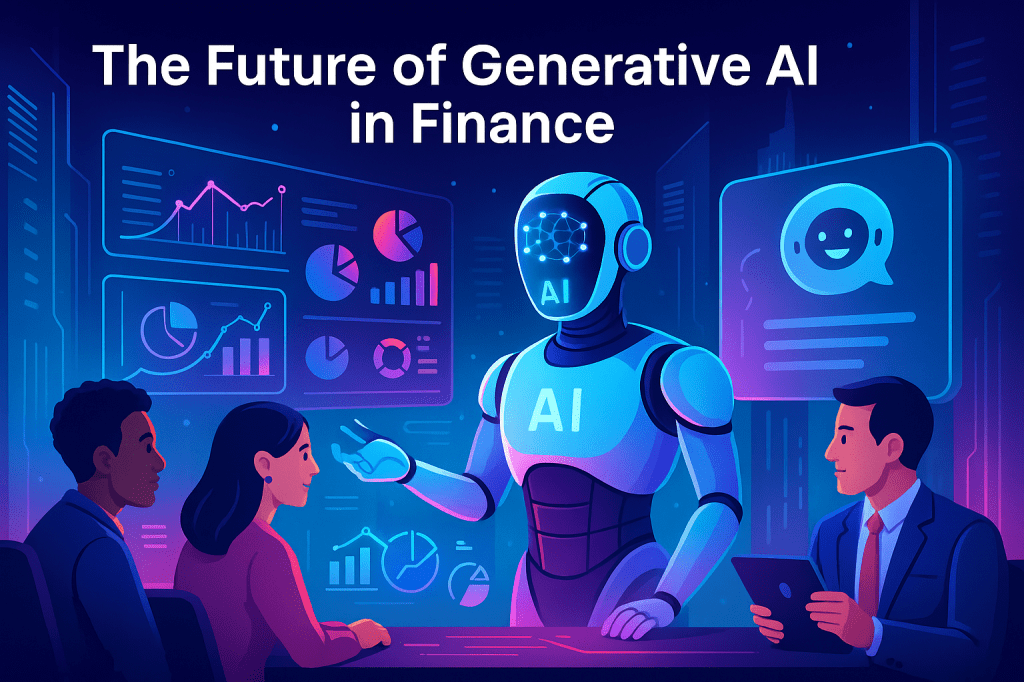
AI has already changed the financial services business in many ways, from finding fraud and managing risk to algorithmic trading and customer service. Generative AI, a kind of AI that can create new things like text, graphics, code, and even financial models, is a new step in the growth of finance.
Statista says that the worldwide generative AI market in finance will develop quickly, from $1.09 billion in 2023 to more than $12 billion by 2033. This is a compound annual growth rate of 28.1%. Fraud detection is still an important use for Generative AI, but the technology is about to change the sector in ways that go well beyond security. In 2024, 52% of financial services organizations will be employing it, up from 40% in 2023.
This article looks at how Generative AI might change the financial industry by looking at how it is now used, what it could be used for in the future, and the problems that come with using it. Generative AI is going to change how banks work and how they talk to their consumers. It can do things like provide individualized financial advice, create fake data, and make content automatically
What is Generative AI?
Generative AI is a kind of AI model that can generate new content by finding patterns in data that already exists. Generative AI produces new outputs instead of just classifying or predicting things as standard AI models do.
- Text: Making reports, summaries, or messages to customers.
- Images: Making pictures of financial data or market patterns.
- Code: Writing software or automating coding activities.
- Audio/Video: Making tailored financial material or simulations.
- Financial Models: Making fake datasets or simulating market situations.
Generative Pre-trained Transformer (GPT), DALL·E, and Stable Diffusion are three well-known generative AI models that have been changed to work in several fields, such as finance.
Current Applications of Generative AI in Finance
While Generative AI is still in its early stages in finance, several applications are already gaining traction. These include:
1. Fraud Detection and Risk Management
Generative AI makes existing fraud detection systems better by creating fake datasets that machine learning models may use to learn. These fake datasets may mimic unusual or complicated fraud situations, making detection algorithms more accurate and reliable. Generative AI may also look at a customer’s transaction history and behavior patterns to develop risk profiles for them.
2. Personalized Financial Advice
Generative AI can make unique investment and financial strategies for each consumer. Generative AI can provide personalized reports and suggestions for customers by looking at their financial objectives, risk tolerance, and market movements. This makes customers more interested and happy.
3. Automated Content Creation
Generative AI is being used by banks and other financial organizations to make marketing materials, financial reports, and contacts with customers. For instance, GPT-based models may make individualized investment newsletters, product descriptions, or emails to welcome new customers, which saves time and money.
4. Synthetic Data Generation
Generative AI can generate fake datasets that seem like actual financial data. This is very helpful for testing and training AI models in a safe and private setting. You may also utilize synthetic data to create market scenarios for stress testing and scenario analysis.
5. Code Generation and Automation
Generative AI may help programmers write code for financial apps like trading algorithms and systems for managing risk. Generative AI may speed up the development process and cut down on mistakes by automating coding processes that are done over and over again.
The Next Frontier: Beyond Fraud Detection
Fraud detection is still a major use for Generative AI, but it might also open up new possibilities in finance. These are some of the most exciting places for new ideas:
1. Hyper-Personalized Financial Services
Generative AI can look at a lot of consumer data and make financial goods and services that are very specific to each individual. For instance:
- Customized Investment Portfolios: Generative AI may create portfolios that are perfect for a customer’s risk level, financial objectives, and the state of the market.
- Personalized Savings Plans: Generative AI can look at a person’s spending habits and suggest ways for them to save money that will help them reach their financial objectives.
- Dynamic Insurance plans: Generative AI can make insurance plans that evolve to meet a customer’s demands, such as modifying coverage depending on changes in their lifestyle.
2. Virtual Financial Advisors
Generative AI can enable virtual financial advisors who help consumers in real time and via conversation. These advisers can:
- Answer Tough Questions: Generative AI can comprehend and answer client questions in real time thanks to natural language processing (NLP).
- Give Investment Advice: Generative AI can look at market patterns and make individualized investment suggestions.
- Simulate Financial Scenarios: Generative AI can assist clients in comprehending what can happen with their money by creating fake situations.
3. Synthetic Market Data for Research and Development
Generative AI can generate fake market data to test investment strategies and create fake trading conditions. This is very helpful for:
- Backtesting Trading Algorithms: Generative AI can generate historical market data that can be used to see how well trading algorithms work in various situations.
- Stress Testing: Generative AI can assist banks and other financial institutions in figuring out how well they can handle big market shocks by putting them through severe market situations.
- Product Development: Generative AI may create fake data to test new financial goods and services before they are made available to the public.
4. Automated Financial Reporting
Generative AI can make financial reports automatically, which saves time and cuts down on mistakes. For instance:
- Regulatory Reporting: Generative AI can make compliance reports that fulfill the rules set by the government.
- Investor Communications: Generative AI can make quarterly financial reports, presentations for investors, and other communications that are customized for different groups of people.
- Internal Reporting: Generative AI can make internal reports for managers that show how well the company is doing financially and how efficiently it runs.
5. Creative Content for Marketing and Branding
Generative AI can create interesting material for marketing and branding, such
- Personalized Ad Campaigns: Generative AI can make ads that are tailored to each consumer depending on what they like and how they act.
- Financial Education Content: Generative AI can develop films, infographics, and articles that teach people about money so they can make smart choices.
- Brand Storytelling: Generative AI can write interesting stories that fit with a bank’s brand values and message.
6. AI-Driven Market Simulation and Forecasting
Generative AI can mimic market circumstances and predict future trends, which may help you make better decisions. For instance:
- Market Scenario Analysis: Generative AI may make up fake market scenarios to see how changes in interest rates or geopolitical issues can affect the economy.
- Economic Forecasting: Generative AI can make predictions about economic variables like GDP growth, inflation, and unemployment rates by looking at past data and present patterns.
- Portfolio Optimization: Generative AI can test out multiple portfolio strategies to find the best way to divide up assets depending on goals for risk and return.
Challenges and Ethical Considerations
Generative AI has a lot of promise in finance; however, using it also comes with problems and moral issues:
1. Data Privacy and Security
Generative AI needs a lot of data, which makes people worry about the safety and privacy of that data. Banks and other financial organizations must make sure that client data is safe and utilized in accordance with laws like GDPR and CCPA.
2. Bias and Fairness
Generative AI models might unintentionally retain biases that are already in the training data, which can lead to unjust results. Banks and other financial organizations need to make sure that their AI systems are fair and open and that they don’t treat any customers unfairly.
3. Regulatory Compliance
When using Generative AI in finance, you have to follow rules about things like risk management, protecting consumers, and stopping money laundering. Financial institutions need to engage closely with authorities to make sure their AI systems follow the rules.
4. Explainability and Transparency
Generative AI models may be hard to comprehend and complicated, which makes it hard to explain why they made certain choices. Financial institutions need to make sure that their AI systems are easy to understand and explain so that clients can see how choices are made.
5. Job Displacement
Generative AI’s ability to automate processes might mean that certain jobs in finance will no longer be needed. To keep up with the changing world, banks and other financial organizations need to spend money on training and retraining their employees.
The Future of Generative AI in Finance
Generative AI has a promising future in finance, and new developments will keep pushing the field further. According to Gartner, AI in finance is changing quickly, with 75% of banking executives now using or intending to use generative AI.
Hyper-personalized digital banking, autonomous finance, better fraud detection, and embedded financial services are all key innovations that will help banks make more money and work more efficiently. Some important trends to keep an eye on include
1. Integration with Other Technologies
More and more, generative AI will work with other technologies like blockchain, quantum computing, and the Internet of Things (IoT) to create new financial goods and services.
2. Expansion into New Areas
Generative AI will move into new sectors of finance, such as decentralized finance (DeFi), ESG (Environmental, Social, and Governance) reporting, and sustainable finance.
3. Collaboration Between Humans and AI
In the future, people and AI will work together in finance. AI will not replace people, but it will make them better. AI technology will help financial professionals make better judgments and provide customers better experiences.
4. Ethical AI Development
As Generative AI becomes more common, there will be increased attention on developing AI in an ethical way, with an emphasis on justice, openness, and responsibility.
Conclusion
Generative AI is about to change the financial services sector in a big manner by giving financial institutions new tools and changing the way they do business. There are countless options, from highly tailored financial services to fake market data and automatic content production.
However, there are additional problems and moral issues that need to be dealt with when using Generative AI. To get the most out of Generative AI, banks and other financial organizations need to put money into strong data governance, make sure everything is fair and clear, and follow all the rules.
As we enter a new age in finance, the key to success will be to embrace new ideas while figuring out how to use this game-changing technology. By doing this, banks and other financial institutions may find new possibilities, improve the experiences of their customers, and remain ahead in a market that is becoming more competitive.
 Tech Update HQ